
Origin of Story: Yamas Village
Informant: Mr. N. Owse
Translator: Yufen A. Biakai
In a forest hamlet, there once lived an elder grandmother named Janseaot along with her nine grandchildren. By order of birth from the eldest, their names were Ker, Ofopirat, Okoripit, five subsequent brothers each named Beorpit, and the youngest, a female child named Ecowasiraot. The father and mother of these nine siblings had long passed away; consequently, the youths strove to sustain themselves. In truth, Grandmother Janseaot held deep affection for them, though she would ultimately resolve to slay them on account of a grave transgression.
It is recounted that Grandmother Janseaot secretly kept a snakehead fish (usi or us). The fish was bound with a rattan cord (tem cima) and moored to a nipa palm trunk along the riverbank. Janseaot examined it only in secrecy so as not to be seen by her grandchildren. One day, Janseaot ventured into the forest alone to pound sago, purposing to prepare provisions to feast upon with the fish, which she intended to harvest two days hence.
During the grandmother's absence, Ker and his brothers (excluding Ecowasiraot) were hunting mudskippers using bow and arrow (apon or apan). By chance, a mudskipper perched upon the back of the grandmother's captive snakehead. They loosed an arrow at the creature, piercing straight through the body of the great fish beneath. Only when the fish began to thrash violently did they perceive its immense size. Reaching down into the water, they discovered the cord bound to its gills, recognizing at once that it was their grandmother's prized possession.
Though aware of its origin, they resolved to consume it before their grandmother's return. They prepared and ate the fish voraciously, turning it into a feast, while mocking the youngest sister:
“We shall grant you not a single morsel of this flesh, for you will surely betray us.”
Ecowasiraot wept bitterly throughout the day, overcome by sorrow and fearful of being implicated in the misdeed. Turning the matter over in her mind, she gathered the fish bones, concealed them within her hair, and sought out her grandmother in the forest hamlet. There, she implored the elder to groom and search her hair for lice. Her grandmother asked:
“Why do you not beseech your brothers to do this?”
Yet, moved by kinship, Janseaot complied. How profound was the grandmother’s shock upon discovering the fish bones woven into her granddaughter's hair. She wailed aloud, heaping curses upon the deeds of her grandsons. Tragically, though Ecowasiraot had sought only to reveal the truth, she too was deemed guilty by the grandmother. In the apex of her fury, Janseaot seized Ecowasiraot and cast her down upon a sago frond.
“I transform you into a frog. Eco, sound forth your call: kara… kara…, for such shall be your voice through all generations.”
The Flight and the Sacred Jeer Tree
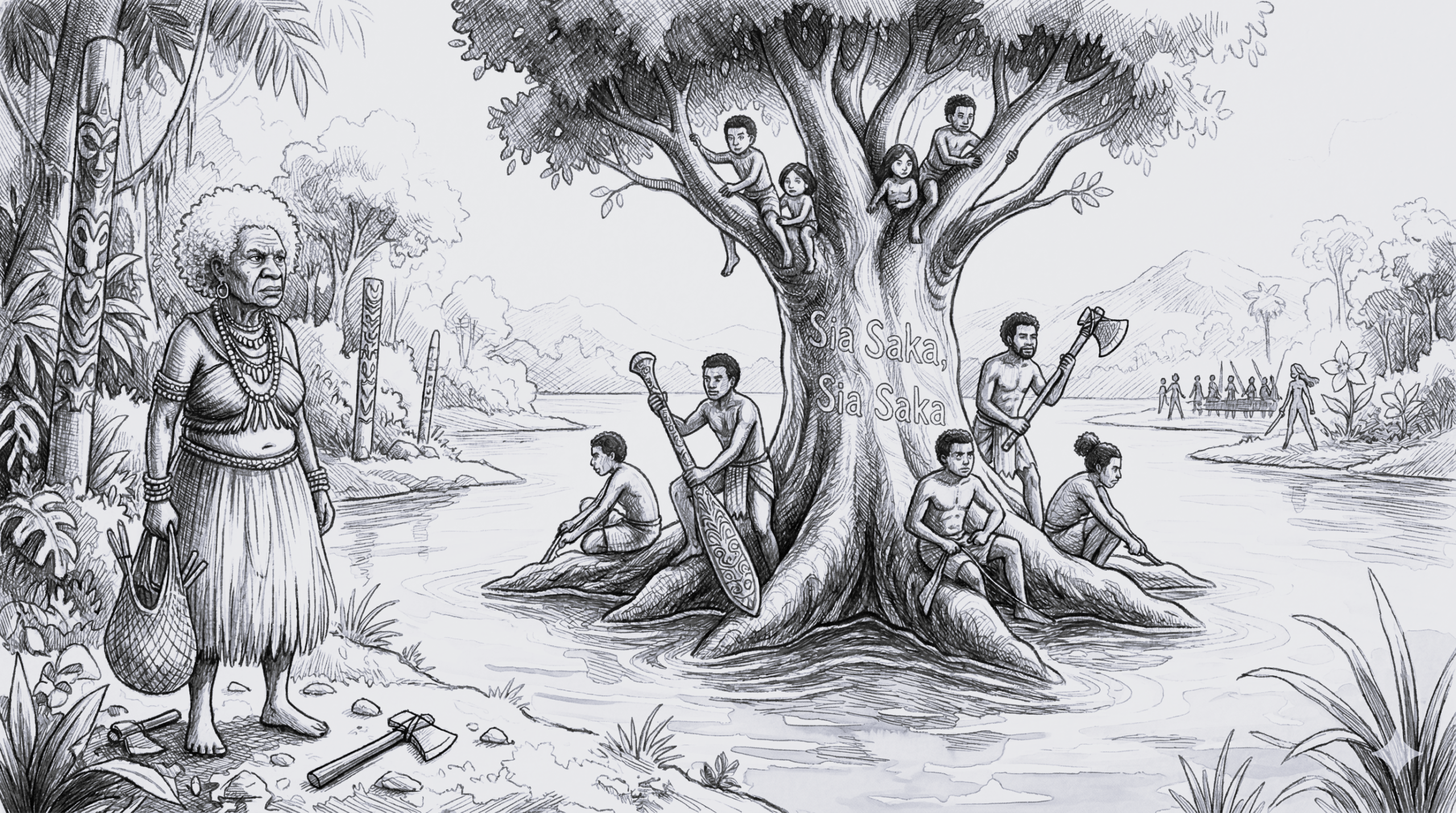
Having cast her curse upon the youngest, Janseaot returned home intent on exacting vengeance upon her grandsons; yet the dwelling was entirely deserted. Ker and his brothers had already fled. They had sought refuge by attempting to climb several hollow, withered trees, but each collapsed beneath them. At last, they came upon a Jeer tree (a species of sea almond), rooted high on an elevated ridge and endowed with sacred mystical power (cesar).
Prior to their ascent, they consecrated the tree’s trunk with a sacred charm (eram jini), uttering an incantation:
“We bestow upon you the name of our ancestral forebears. If Janseaot strikes you down, cry out: sia saka, sia saka! (may the stone adze shatter!). Should she succeed in felling you, leap forth into the midstream of the river and bear us upon the waters to a rightful sanctuary, that we may begin life anew.”
Janseaot pursued them, carrying a woven bag filled to the brim with stone adzes. As her blades struck the trunk, a voice resonated from within the wood: “sia saka, sia saka.” Janseaot cried out in bitter rage:
“Pity upon you, my grandchildren, where do you hope to flee? I bear a bag laden with stone adzes to bring an end to you all!”
One by one her stone adzes fractured, each replaced by another, until at last the tree was severed. Yet, before its crown touched the earth, the Jeer tree sprang into the depths of the river according to the plea of Ker and his brethren. Janseaot stood defeated in bitter sorrow, left to dwell in isolation amidst her ancestral wealth.
The Settlements of Women and the Buzz of the Bees
The Jeer trunk drifted downstream toward the estuary. Along their passage, the brothers traversed several settlements inhabited solely by women. Among them were the Kokotam Cepes, who possessed blade-like legs yet fair countenances, and the Bi Jimiis Cepes, whose forms were robust yet bore flat noses.
Whenever the trunk drifted past these settlements, the women attempted to seize the timber to serve as firewood (jis). To evade capture, Ker and his brothers mimicked the droning hum of bees: “Ngenggg… ngenggg…”. Fearing the sting of the swarm, the women released the wood, allowing it to float onward down to the river mouth.
Life Among the Taar Cepes
At the river's estuary, they entered the domain of the Taar Cepes (the Lily Women), maidens renowned for their extraordinary beauty. This time, Ker and his brothers withheld their imitation of bees, captivated by the women's grace. The women of Taar Cepes brought the drift timber ashore.
Bitiaot, the eldest among them, summoned her sisters to set out for the sago groves to harvest sago grubs. As they journeyed, they called aloud: “To the forest groves, and to the riverbanks, is to walk.” This expression carries the profound philosophical understanding that human existence is an enduring endeavor to maintain harmony between the terrestrial land (wasen are) and the waters (bu are).
While the women were away, Ker emerged from within the wood and encountered Taaraot.
“What wondrous being is this? Formed in the likeness of humankind, exceedingly handsome,” Taaraot marvelled. “My name is Ker, I am the firstborn,” he replied.
The two were bound by mutual affection. In accordance with their seniority of birth, Ker’s brothers were likewise betrothed to the maidens of Taar Cepes and concealed within rolled pandanus mats (tapen) near the hearths. Taaraot sprinkled the mats with water to make it appear as though a heavy downpour had just drenched the dwelling.
When the other women returned from the sago groves, they were astonished to find their sleeping mats soaked, yet cried out in joy upon discovering their handsome suitors:
“Aia dormipit akat a! (Ah, truly handsome is my husband!).”
Only the youngest maiden of the Taar, Aikunaot, was initially left without a spouse, for the brothers had deliberately left the youngest Beorpit within the hollow wood. Yet at last, the youngest Beorpit was discovered; he was the most handsome of all, gifted with extraordinary prowess in every craft (cescu).
The Tragedy of the Breadfruit and the Dawn of a New Life
As the seasons passed, they were blessed with many descendants. One day, while the youngest Beorpit was gathering breadfruit, a fruit plummeted from the canopy, striking his infant child upon the head and taking its life. In bitter grief, his wife cast sharp reproaches upon him:
“You have crushed my child, taking its very breath away!”
Weighed down by profound shame and sorrow, Beorpit urged his elder brothers to depart in secret. In a newly chosen land, they erected a ceremonial longhouse. Yet the youngest brother took no part in building the dwelling; instead, he ventured into the forest to carve ancestral figures bearing the likeness of their wives.
After three days of labor, he anointed the carved figures with a sacred charm (eram) and struck the ceremonial drum. Miraculously, the wood carvings stirred to life, transforming into living, beautiful women. Thus did Ker and his brothers regain their enduring harmony, dwelling in prosperity as in days of old.
