
Origin: Atsj Village
Narrated by: Michael Binkumces
Translated by: Yufen A. Biakai
It is recounted that in ancient times, along the middle reaches of the Sirets River, there lived a young man named Pis. His daily occupation was hunting, and he was remarkably skilled, ensuring that the entire village continually partook in his yield. During that era, there also lived a maiden of renown named Bis, who in other places was called Bisaut. Her name was heralded far and wide for her extraordinary beauty.
Bis was wed to Pis not for the young man's physical appeal, but for his prowess in hunting, ensuring that Bis's parents would continually receive a share of the game. Another consideration was that Pis suffered from kaskadu (scaly skin/a dermatological condition). In those times, it was customary to give a maiden of great beauty in marriage to a man afflicted with kaskadu, as it was widely believed that such men seldom struck their wives, thereby offering hope that Bis would dwell in happiness and be well-cared for.
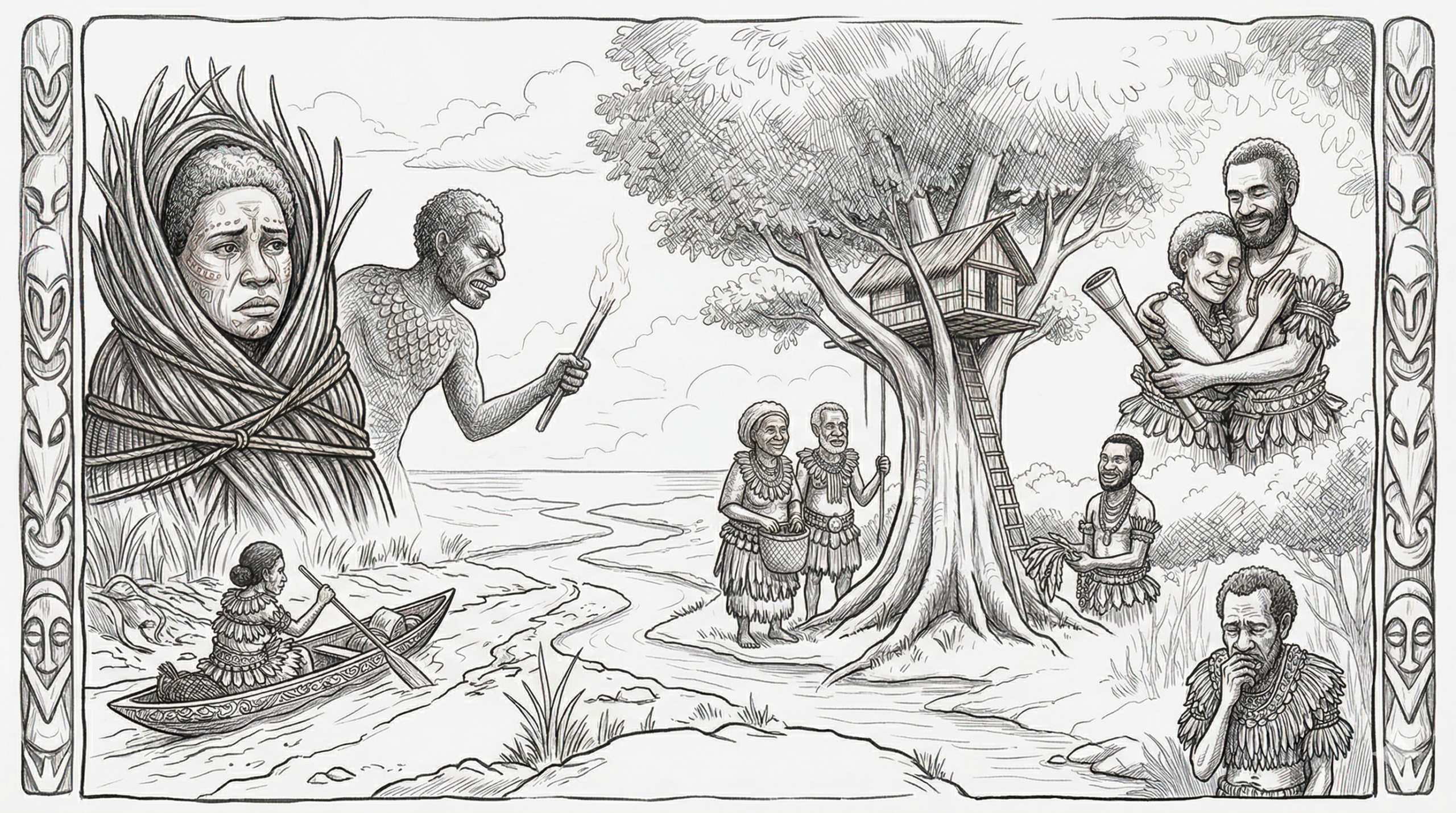
Yet this hope proved vain. Pis treated Bis with extreme cruelty. He confined her within a tapen (mat), tightly sewn shut with pandanus root twine. Bis was forced to eat and drink within the confines of this woven shroud. She was never permitted to stand, not even to relieve herself, causing her body to emanate a foul odor. Pis further barred the entrance of his dwelling with the hull of a dismantled canoe, bound securely with rattan so that none could enter. Should he discern any sign that the threshold had been breached, he would torment Bis with fire until her skin was nearly consumed. Bis endured her plight with forbearance, and her parents initially did not intervene. However, the villagers urged the parents to act, until they at last resolved to carry out a secret plan to deliver their daughter.
One day, while Pis was away, Bis’s parents came to the dwelling. There they encountered his other two wives, Fin and Jak, whose fates were not as wretched as Bis’s. The parents shared their intention, and the two wives agreed to assist, unable to bear the sight of Bis’s ceaseless suffering. Shortly after the parents departed, Pis returned bearing five wild boars. Calling from his canoe, he commanded Fin and Jak:
“Come down and take this quarry!”
Upon reaching the house, Pis observed traces indicating that the door had been moved. Instantly, he beat Bis and scorched her flesh with fire. Such atrocities were repeated without fail each time he returned from the hunt.
A favorable moment arrived when the village leader proclaimed a war expedition, in which Pis took part. Fin and Jak hastened to assist Bis’s parents in cutting open the mat that enclosed her graceful form. They unbarred the door and escorted her to the river to bathe, while the villagers looked upon the marks of Pis’s brutality with dread. Bis’s mother, alongside Fin and Jak, prepared household implements, nets, and a canoe. Bis then set out down the Sirets River. She navigated a shortcut known as Betch wu toward the Betch River. Along the way, however, her craft ran aground due to the receding tide. Compelled to drag the canoe ashore, she proceeded on foot, guided by the sound of a horn that seemed to summon her onward.
As she journeyed toward the Apam River, Bis wept, lamenting her misfortune: “Never have I seen a woman subjected to such treatment. What manner of fate has befallen me?” Rain began to fall, as though the ancestors wept in mourning with her. She briefly sought refuge beneath a Ci tree before pressing onward to the As River. From afar, she beheld a dwelling perched high in a jeer tree. With tears marking the close of her long affliction, she approached and found an elderly woman splitting firewood. The elder, startled, inquired:
“Whence come you, and who might you be?”
Bis replied: “State your name first.”
The elder woman answered: “My name is Teweraut. My husband is Botok Simit. We are gathering firewood.”
Bis then declared: “My name is Bis. My husband is Pis. I was bound within a mat, sewn tight with pandanus roots. I have fled, and I seek As Beworpit to be my new husband.”
Upon hearing this, Teweraut embraced her, exclaiming: “Ah, how beautiful a daughter-in-law I have received.” Her husband, Botok Simit, was likewise overjoyed. They concealed Bis within the canoe so she would remain unseen by others, and transported her to the village as dusk fell.
In the village, As Beworpit continued to blow his bamboo horn, unaware that the woman he had long desired was already at his parents’ home. When he descended to eat, he stood awestruck at the sight of Bis. His father presented her, saying: “Behold Bis, the one of whom you have dreamed.” Beworpit, finding it difficult to believe, remarked: “Nay, that cannot be; she is my sister.”
He climbed back into the tree to contemplate, suspecting that his parents were merely jesting. Driven by curiosity, he descended once more and questioned her directly: “Are you truly Bis, as my parents have spoken?”
Bis replied: “Indeed, I am Bis.”
Beworpit embraced Bis with profound joy, and together they ascended to the dwelling atop the jeer tree.
Meanwhile, Pis returned from the war and called out to his wife: “Bis, take this enemy skull!” The other women mocked him: “Pis, your wife Bis has departed.” Pis immediately cast himself into the mud and wailed for days on end. On the third day, he enlisted Deso, Bis’s brother, to help track his wife’s path. They found her overturned canoe at Betch wu, but lost her trail deep within the forest. Overcome with remorse for his misdeeds, Pis wept bitterly and returned home in despair.
Deso, however, pressed on until he came upon the dwelling atop the jeer tree. He watched his sister, Bis, descend from the tree. The siblings embraced one another with tears of relief. Bis then ascended again to the treehouse and embraced her husband, Beworpit. Puzzled by her conduct, Beworpit inquired: “What is the meaning of this?”
Bis replied: “I do this to assure the safety of my elder brother Deso, who stands below in search of me.”
Moved by her devotion, Beworpit welcomed his brother-in-law with honor. Deso resided with them for several days while Beworpit’s kin assembled an abundant bride price for him to carry back. In time, news of Bis’s newfound peace reached her ancestral village.
Learning that Bis had become Beworpit’s wife, Pis wept until his eyes were swollen. Yet he refused to surrender. He beseeched Deso to accompany him once more to retrieve Bis through peaceful means, carrying many woven noken bags laden with stone axes as an offering of redemption. Upon arrival, Pis’s heart broke as he witnessed Bis descending from the jeer tree. Although Beworpit received them with grace and was even willing to relinquish Bis out of sympathy for Pis’s devotion, the final choice lay with Bis herself.
Beworpit asked her: “Will you return to your husband, Pis?”
Bis refused firmly: “I will not.”
Pis returned home engulfed in profound grief. He languished in ceaseless mourning for Bis until his body withered away, and he breathed his last.
Note: This tradition serves as an ancestral teaching for Asmat men to treat their wives with justice, honor, and dignity. For neglect and cruelty bring forth only ruin, as was the fate of Pis.
