
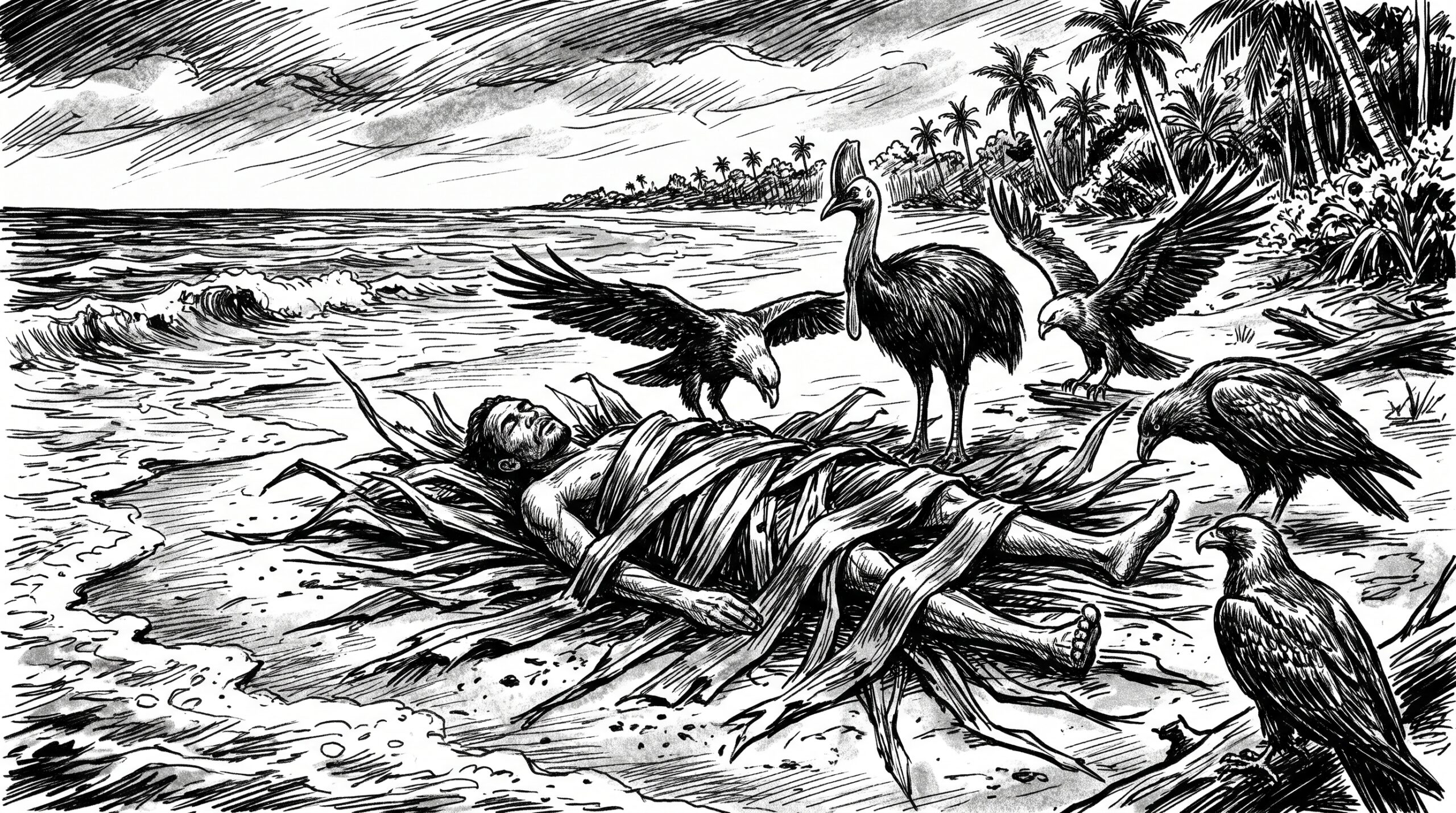
Fumiripits: Reinterpreting the Creation Narrative of the Asmat People
In nearly every human civilization, we encounter narratives of origin and creation. These accounts emerge from inquiries that are profoundly simple yet consequential: whence did we originate, and whither do we journey after death? “Must we, in seeking to understand life, invariably return to the original creator, or is it sufficient to discern how we exist and dwell among fellow creations?”
The Asmat encompass diverse languages, histories, and traditions that have flourished within an expanse of swamps, rivers, forests, and coastlines. As a hunting and gathering society, the life of the Asmat people has from time immemorial been intimately intertwined with their natural surroundings. Knowledge concerning nature, ancestors, spirits, and human kinship is transmitted through narratives, myths, songs, rituals, and the manifold symbols embodied in carvings, shields, paddles, canoes, and other material culture.
Owing to the intimate affinity of the Asmat with wood as the principal medium of their carving, numerous writings on the Asmat have associated them with the figure of Fumiripits—a being within Asmat mythology who is frequently conceived as a creator figure.
I sought to re-examine this prevailing understanding by conducting interviews with traditional elders from Syuru, Amborep, Jamas, and Sawa Erma. My objective was to ascertain how they themselves perceive Fumiripits, and whether he is indeed regarded as the creator of the Asmat people.
The account of Fumiripits was first recorded by Father Zegwaard, MSC, during his mission in Kokonao in 1949. In that narrative, Fumiripits finds himself in perilous destitution, suffering and near death. He then receives aid from a bird. Subsequently, he crafts a tifa drum and wooden figures, which he then brings to life.
While Fumiripits is frequently interpreted as a creation myth, the narrative of his survival constitutes, in truth, an overarching testament to the nature of Asamat—humanity within the cosmos. This tradition may be read as an account of ingenuity, fortitude, and the human capacity for endurance. Fumiripits is not merely an entity who creates; he is a human being beset by hardship who discovers deliverance through his inherent capabilities.
Yet, an illuminating insight emerged from my dialogues with several customary elders.
To them, asserting that the Asmat originate from wood or were fashioned by a mortal being such as Fumiripits is not an appropriate manner of articulating their origins. Indeed, such an interpretation may be construed as an indignity.
When recounting origins, the Asmat speak far more of the journeys of their forebears: whence they arrived, how they migrated from one land to another, and how they cultivated relationships with other territories and kindred groups.
The question of the first human being does not appear to be of primary concern.
What holds far greater significance is the position of humanity amidst the wider creation.
Within this ontological framework, existence is not merely a linear continuum commencing with birth and concluding with death. The spirit descends into the world, traverses this life, and subsequently returns to the spiritual realm. Existence thus constitutes a pilgrimage between the corporeal world and the realm of the spirits.
Perchance for this reason, Fumiripits need not invariably be understood as a “creator” in the conventional Western sense. His narrative may be received as a testament to humanity, life, the faculty of creation, and the communion between the living world and the ancestral realm. Therein lies the true essence of Asamat—the human being.
Perhaps the more imperative inquiry is not “Who created the Asmat people?”, but rather “How do the Asmat perceive their being within the world?”
And it is perhaps from this juncture that we may begin to comprehend Fumiripits through a renewed perspective.
