
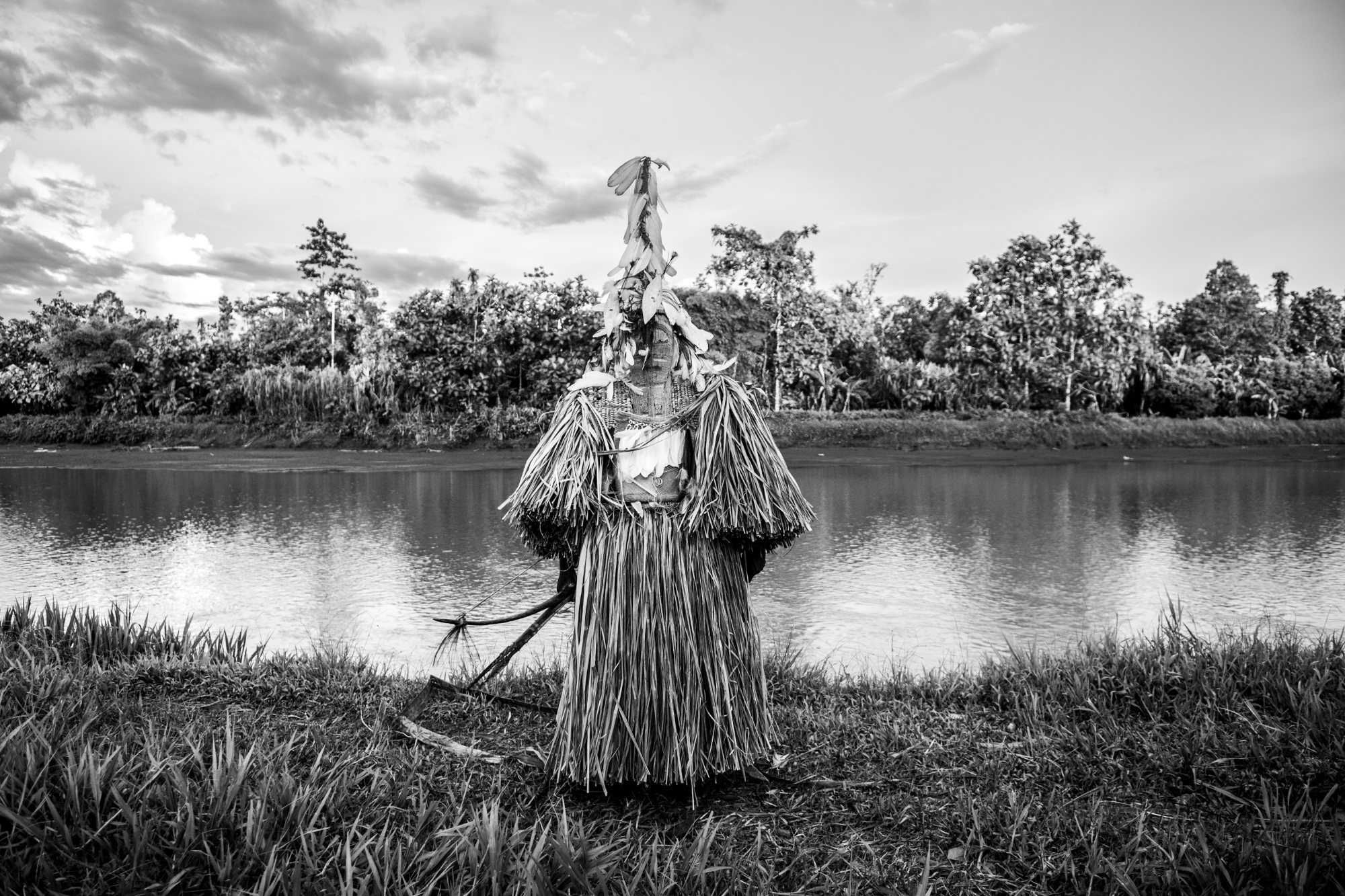
At the end of 2022, several traditional elders from Esmapan Village visited my house in Er Village. The distance between the two villages is about 30 kilometers by fiber boat. They invited me to attend the Jiwi ceremony and assist in documenting it. In the Asmat indigenous community, which practices an oral tradition, photography is a means of maintaining collective memory and creating a legacy for future generations. I took pictures and recorded songs and the events of the feast. This series of photos documents a Jiwi ritual in the Asmat community of Esmapan Village. The Jiwi ceremony is a special occasion for the Asmat people to commemorate their deceased ancestors. Through the ritual, they reestablish a balanced relationship between the living and the ancestral spirits.Unfortunately, there is a misconception among outsiders that this ceremony is called the Devil’s Celebration. This view creates a negative impression that does not align with the ritual’s true meaning, which is to show respect for ancestors. The ritual provides the Asmat people with certainty and a sense of security. By visually representing their ancestors through carvings on Bisj (ancestral statues), the Asmat people make the invisible tangible. During the Jiwi ceremony, ancestors “visit” the world of the living, providing strength and ensuring a lasting connection. These visits dispel fear and doubt while serving as proof that their ancestors will continue to protect and support them. In a fragmented world, the Asmat people believe that human existence is inseparable from the spirits of ancestors, nature, humans, and God. Amidst the current wave of modernization that is beginning to affect the lives of the Asmat people, the Jiwi rituals are a true manifestation of coexisting with the invisible. Having lived with the Asmat community since 2016, I photograph from within, not as an outsider. My work is not tourist documentation, but rather a form of respect for the Asmat world. Through my photographs, I aim to show the audience how the Asmat community maintains a deep connection with the spirits of their ancestors and their land. Amidst the ecological crisis and the alienation of modern humans, the Jiwi ritual offers valuable lessons in sustainability and respect for life. Ndoro, standing on the banks of the Momats River, preparing to return to the forest—the world of spirits. The Tifa players began to sing sacred hymns inviting the spirits. The ancestral tifa—heritage began to be heated in the fireplace. The young men representing each clan began to weave spirit masks. Ong, ensured that all masks were woven according to ancestral traditions. Timno, accompanied by his son, made a new Tifa to be presented to the ancestors. In between this series of traditional rituals, Father Vince led a holy mass to pray for the ancestors in accordance… A Noken with the words, 'West Papua' belonging to Matias was hung near the spirit masks that would be prayed… Bepja and other traditional figures, weaved "Manmar" a special mask as the Mother of the spirits who would lead the… The spirits began to be invited from the forest—the world of spirits to return to the village. Simon with a special shield decorated with sacred symbols that will be offered to the ancestors. Children run to avoid evil spirits that also come to the village. They throw fruits at evil spirits so that evil spirits do not bring bad things into the midst of life… Markus stands in the middle of the traditional house, starting to call the names of the ancestors they are praying… Ndoro walks through the village. They give offerings of sago worms to the ancestral spirits. Grief covers them when the ancestors visit the family one by one. Peto is unable to let go of the ancestors who will return to the forest Taksa, letting go of his longing for the spirit of his father, who is visiting.
